Where Do Older Pedestrians Experience a Risk of Being Killed in a Motor Vehicle Crash?

Our newest paper just came out in the Journal of American Geriatrics Society and shows that across the US, pedestrian fatalities from motor vehicle crashes among older adults cluster around senior centers, community centers, libraries, pharmacies/drug stores, and healthcare/hospital/health services. This work is part of our ongoing research agenda to identify ways to increase pedestrian safety, both for injuries from motor vehicles and for injuries from pedestrian falls.

Walking has a myriad of health benefits and multiple urban planning/design guidelines emphasize creating built environments that support pedestrian activity.  However, concerns around pedestrian safety, from cars and from falls, are a barrier to walking, particularly for older adults. Older pedestrians experience the highest death rates in traffic crashes compared to any other age group, and yet there are no national policies or programs that focus on the making the pedestrian environment safer for this vulnerable group.

The research first involved using the NETS data to identify venues older adults frequently walk to or from, and narrowing our list to focus on establishments typically operated by municipalities (e.g., libraries, senior centers) or licensed by city and state governments (e.g., hospitals) – making them attractive partners for government efforts to improve safety. These public establishments were then categorized into two broader categories for the analysis: 1) residential living facilities (assisted living facilities, continuing care retirement communities, and skilled nursing facilities) and 2) walkable destinations for older adults (senior centers, community centers, libraries, pharmacies/drug stores, and healthcare/hospital/health services).  We analyzed the density of these two metrics at 10,529 locations where a pedestrian was killed in a motor vehicle crash (case locations) between 2017 and 2018 and at two matched control locations per case location. 

Analyses indicated that a higher density of older adult walkable destinations were associated with locations where older adult pedestrians were fatally struck, even after adjustment for the nearby older adult population. For fatalities involving pedestrians age <50 there was no association between these destinations and where pedestrians were killed.  But for pedestrians age 50-64 and 65+ a higher density of these destinations was associated with locations where pedestrians were killed, with the strongest associations for pedestrians age 65+.  A similar pattern of results was observed for the density of residential facilities. 

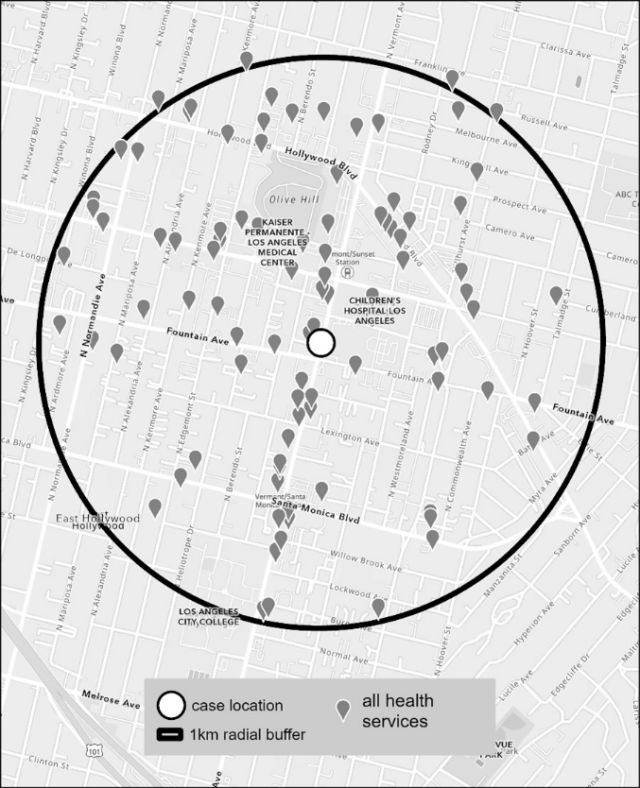
To the left: health services within 1Km of the location where a pedestrian was killed by a motor vehicle.

The identification of specific high-risk environments for older pedestrians will hopefully spur new investments in evidence-based, cost-effective pedestrian safety interventions in these areas, such as leading pedestrian intervals, pedestrian refuge islands, and crossing signage. The studied destinations, facilities and residential settings are typically operated by municipalities or licensed by city and state governments, and so this work suggests some natural partnerships for improving pedestrian safety. As shown in the Figure from the paper, areas with high concentrations of health care facilities, like city medical centers, may be especially important areas for cities to focus their pedestrian safety efforts to prevent older adult pedestrian injuries.  

Posted in Active Transport, Adults, Health Care Access, Injury, Safety, Transportation, Walkability | Leave a comment

Tree Canopy Cover Linked to Lower Risk of Pedestrian Falls

Our latest research, just published online in the American Journal of Epidemiology, suggests that higher levels of tree canopy cover helps prevent injurious pedestrian falls. The research found that during summer months, locations on streets and sidewalks where pedestrians fell and suffered an injury were less likely to be shaded by trees than matched control locations. 

Indoor falls have been well studied and there are multiple sets of guidelines to prevent these falls. However, outdoor pedestrian falls have received far less attention, despite accounting for an estimated half a million injurious incidents in the U.S. each year. In our previous work we showed the high burden and morbidity associated with outdoor falls on streets and sidewalks. Walking has multiple health benefits, but among older adults fear of falls is often cited as a barrier to engaging in walking.

 We analyzed data on tree canopy cover at 497 locations where Emergency Medical Services attended to pedestrians injured in a fall between April and September 2019 and at 994 carefully matched control locations. Tree canopy cover at each location where an injurious fall occurred and at matched control locations was measured using the 2019 National Land Cover Database. Average tree canopy cover at fall locations was 8 percent, compared with 14 percent at control sites. In adjusted analyses higher tree canopy cover was inversely associated with fall locations (adjusted OR across the inter-quartile range of canopy cover = 0.57, 95% CI: 0.45, 0.74). 

Many cities have tree planting campaigns, particularly street trees, but these campaigns are controversial because street trees can cause sidewalk damage, and residents worry that this damage will increase the risk of falls.  In many areas home/building owners are responsible for sidewalk maintenance and are liable if someone falls on the sidewalk in front of their building.  Our work provides new evidence that urban trees, perhaps through cooling the local ambient environment, contributes to pedestrian safety.  High temperatures can increase fall risk by adversely affecting human physiology and by degrading road and sidewalk surfaces. High heat softens asphalt and causes sidewalk pavers to pop out of alignment creating trip and fall hazards. The work we present in AJE supports cities’ initiatives to expand the urban forest and tree canopy cover.

Posted in Active Transport, Adults, Injury, Pedestrian Injury, Physical Activity, Safety, Urban Design, Urban Forestry | Leave a comment

Expanding the BEH Research Portfolio

This summer we had the good fortune to start working with Emergent BioSolutions and have recently completed our first round of deliverables: an abstract accepted to the American Public Health Association (APHA) conference; and a paper on new methods to analyze National Emergency Medical Services Information System (NEMSIS) data submitted to a journal for publication and posted to the MedRxiv pre-press server.  We have two more research papers in the works, written in collaboration with Emergent BioSolutions researchers.

Our methods paper on analyzing NEMSIS data seeks to improve researcher’s ability to make inferences about patient-level events in the NEMSIS data.  The NEMSIS data is organized such that each row of data reflects an EMS response, not a patient per se.  So if, for instance, two EMS units respond to a single patient event, data about that patient is recorded in NEMSIS twice.  As a result, using the NEMSIS data to make inferences about patients, such as how many patients were administered a particular treatment as part of their pre-hospital care, is difficult. 

The paper presents a method for identifying duplicate (or more) records in the NEMSIS data generated from the treatment of a single patient by multiple EMS units.  Our analyses of EMS responses in NYC in 2024, found that there were 32,202 EMS responses to provide assistance to individuals injured in assaults, but we estimate that these responses represent 26,451 patients. We will be using this approach to record de-duplication to improve our research on neighborhood influences on pedestrian injuries, drug overdoses and violence.

Posted in Injury, Methods, Pedestrian Injury, Safety, Transportation | Leave a comment

The Links Between Vibrant Retail Business Environments and Resident’s Health

We have completed a series of studies showing that neighborhood access to small and medium size retail businesses that provide for community member’s living needs – the goods and services we need to function, live and thrive, such as banks, supermarkets, drug stores, gyms, corner markets – is associated with better health.  Nearby access to such businesses in a residential neighborhood is associated with greater engagement in walking and active transport to complete living needs like shopping, banking and socializing, which increases overall physical activity.  These businesses also provide opportunities for purchasing healthy food, engagement in physical activity and social connections. 

In our work with the NYC Department of Health and Mental Health (DOHMH) to study neighborhood influences on pregnancy health we showed that a higher density of these types of businesses was associated with lower risk of excessive gestational weight gain and lower risk of gestation diabetes. In another project with DOHMH we showed that a higher density of retail food outlets overall in a residential neighborhood is associated with lower body mass index. In earlier work studying childhood obesity in ~94,000 NYC school children we observed that greater retail presence in a neighborhood was associated with lower risk of obesity.  We have also shown that a higher density of businesses that support living needs are associated with lower risk of incident cardiovascular events. In each study we theorize that access to these retail outlets increases engagement in active transport, and thus physical activity, among residents of the neighborhood.

The density of these types of retail businesses is also one of two components, along with population density, that make up our national neighborhood walkability index. Using this index we have shown that higher walkability (measured as population density and business density) is associated with lower risk of obesity related cancers, lower risk of developing diabetes, and lower weight gain through time.         

We have also shown in NYC that access to supermarkets, grocery stores and health food stores is associated with lower body mass index and that access to farmer’s markets is associated with greater consumption of fruits, vegetables and meat.  Our work is part of the scientific rationale for the NYC FRESH Initiative that uses loan, zoning, building design and tax incentives to bring grocery stores into underserved neighborhoods.  We testified about our research at NYC Council and Zoning Board meetings as part of the efforts to establish the FRESH Initiative.   

Lastly, we have shown that higher neighborhood access to commercial physical activity venues – gyms, dance studios, martial arts schools, exercise facilities, tennis clubs – is associated with higher levels of physical activity and lower risk of incident cardiovascular events.

Together this work shows that residential neighborhoods with a vibrant retail business environment, that provides commonly and frequently needed goods and services to residents, support healthy behaviors and, in turn, improved health.     

Posted in Active Transport, Body Mass Index, Cancer Incidence, Diabetes, Economic Development, Food Environment, Obesity, Physical Activity, Socioeconomic status, Urban Design, Walkability | Leave a comment

Pedestrian Falls and Alcohol Use

Our recent paper highlights an often-overlooked aspect of pedestrian safety: the role alcohol and drug use play in falls that occur outdoors, particularly on streets and sidewalks. We used data from the National Emergency Medical Services Information System (NEMSIS), which collects and standardizes data from EMS agencies across the USA, to describe the prevalence of drug and alcohol use among falls requiring EMS response. We analyzed the data by location of the fall and distinguished between falls with an indication of syncope or heat illness, as alcohol may play a different role in these falls.

Using over 1.8 million records of falls requiring EMS response in 2019, we found that overall, 7.4% of falls had an indication of drug or alcohol involvement, yet among falls that occurred outdoors on a street or sidewalk 21.2% had an indication of substance involvement. Across almost all age groups the prevalence of alcohol involvement was higher for falls occurring on streets and sidewalks compared with falls occurring indoors. Among those experiencing falls on streets and sidewalks without accompanying syncope or heat illness, adults ages 21-64 had the highest proportion of falls reported to involve alcohol. Further, EMS reports for male patients were more likely to include a report of alcohol and/or drugs than for female patients across all fall locations. The highest prevalence of alcohol use alone, at 25.1%, was found among men experiencing falls on streets and sidewalks, without accompanying syncope or heat illness.

We also found that falls involving alcohol and/or drugs resulted in more severe injury. Falls with a notation of alcohol, drug or both alcohol and drug use were more likely to have Glasgow Coma Scores indicative of moderate or severe head trauma compared with falls without a notation of substance use, particularly among falls that occurred on a street or sidewalk. Substance-involved falls were also more likely to occur during the evening and nighttime compared to during the day.  

Our findings suggest that substance use is present in a large proportion of falls that occur on streets and sidewalks, particularly among men and adults between the ages of 21 and 64. Additionally, falls occurring during the evening and nighttime hours are more likely to involve alcohol, further suggesting that falls on streets and sidewalks that involve alcohol may be in close proximity to businesses that serve alcohol. This is consistent with previous findings that suggest a higher density of alcohol serving establishments is associated with both increased alcohol consumption and increased pedestrian injury from motor vehicles. The increased prevalence of injurious falls involving alcohol among men and adults ages 21–64 is consistent with the higher prevalence of alcohol consumption in these groups in the USA.

These results have significant policy implications, particularly as cities work to revitalize their downtown areas after the COVID-19 pandemic. In many cities downtown revitalization plans include the development and promotion of nightlife or entertainment districts. Our study suggests that substance use may be an important risk factor for injurious falls, and therefore cities should consider policies and infrastructure that can help mitigate injury risk as they plan their downtown developments. Implementing appropriate lighting for commercial areas, improving maintenance of sidewalks and curb cuts and of roadbeds at street crossings can all help mitigate risk of pedestrian injury. States and cities might also re-evaluate policies around nightlife districts and open container laws that encourage the consumption of alcohol while walking.

Posted in Active Transport, Adults, Alcohol, Injury | Leave a comment

Pedestrian Injury Research

Our work on pedestrian safety is an extension of our work on how urban design can be used to support engagement in pedestrian activity and physical activity. As we have built our portfolio of pedestrian injury research, we have come to realize that alcohol use by the injured individual is a common thread for injuries to pedestrians caused by falls and motor vehicles and for injuries to users of micromobility devices (e.g. bicycles, e-bikes, scooters).  In 40% of instances where a pedestrian was killed by a motor vehicle, the pedestrian was under the influence of alcohol when struck. Among pedestrians experiencing an injurious fall, where syncope and heat illness were not contributing factors, substance use prevalence was 30.3% in the age group 21 to 64 years; alcohol use alone for 26.3%, drugs alone for 2.6%, and alcohol and drugs for 1.4%. 

The high prevalence of alcohol use among injured pedestrians is a concern because many cities, as part of economic development plans to revitalize urban centers, are now developing and promoting nightlife and nightlife districts, prominently featuring alcohol-serving establishments.  Nightlife districts encourage patrons to walk between nearby alcohol serving venues. Furthermore, multiple jurisdictions have open container laws, that allow drinking on streets and sidewalks, and to-go alcohol purchases, policies that also encourage walking and drinking.  As cities focus on re-building the nighttime economy after the pandemic, the number of pedestrians under the influence of alcohol is likely to increase. Urban design to protect nightlife patrons from injuries should be incorporated into the development of the nightlife economy.

Continue reading
Posted in Active Transport, Alcohol, Bike Share, CANVAS, Injury, Pedestrian Injury, Physical Activity, Safety, Street View, Transportation, Urban Design, Walkability | Tagged , , , , | Leave a comment

Neighborhood Walkability and Lower Risk of Incident Diabetes

Continuing our collaboration with the NYU Women’s Health Study team (see here) to understand how neighborhood walkability affects chronic disease risk, we recently published a paper showing that higher walkability is associated with lower diabetes risk. 

Among 11,037 women free of diabetes at baseline and followed for a median of 25.6 years, a higher average annual neighborhood walkability index score for the women’s residential neighborhoods was associated with a significantly lower risk of developing diabetes.  Compared to those living in the bottom quartile of walkability index score, those in the top quartile had a 33% (95% CI 26%, 39%) lower risk of incident diabetes.  The associations between walkability and incident diabetes were stronger for postmenopausal women compared to premenopausal women.

Neighborhood walkability is a concept developed by urban planners and describes a set of neighborhood characteristics that support pedestrian activity and engagement in active transport. Walkability is often described in terms of “the D’s” – density, diversity, design, destination accessibility and distance to transit.  Density refers to residential and retail density, diversity refers to the mix of land uses, design pertains to the layout of the street grid, destination accessibility is the availability of destinations to travel to such as stores and parks, and distance to transit is the physical distance to public transportation.  Additional neighborhood characteristics such as aesthetics and safety can also promote walking and are often described as being part of neighborhood walkability. We have developed a Neighborhood Walkability Index (NWI) that can be implemented across the United States going back to 1990.

Posted in Active Transport, Adults, Diabetes, Urban Design, Walkability | Leave a comment

Increases in Micromobility Injuries in the US: Implications for Public Health

Micromobility – bicycles, E-bikes, E-scooters, and hoverboards – has experienced immense growth in recent years, and we just published a paper in the first look section of AJPH exploring how this growth parallels the rise in electric micromobility injuries and what this means for public health. While the definition of micromobility is evolving, in general it refers to any small, low-speed, human- or electric-powered transportation device. In our paper we show the rate of e-bike injuries increased fourfold between 2019 and 2022, while powered scooter injuries nearly doubled. Through our findings, we highlight the need to improve micromobility injury surveillance and strategies for cities to improve user’s safety so that micromobility can be a safe, sustainable, and healthy option for transportation.

We used the National Electronic Injury Surveillance System (NEISS) dataset to compare patterns and trends for 1,933,296 estimated injuries associated with e-bikes, bicycles, hoverboards, and powered scooters. Among key findings, we found that powered scooter injuries exhibited the highest prevalence of alcohol use, followed by e-bike injuries. We also found that when helmet use was reported, in about 20% of patient narratives, injured bicycle and e-bike users were more likely to use helmets than injured powered scooter or hoverboard users. The lowest proportion of helmet use was observed among hoverboard injuries, and these injuries were also more likely to be diagnosed as concussions compared with other modes. As we note in our previous paper published on alcohol and bicyclist injuries, complete and accurate data for helmet use, substance use, other risk factors, and coding of micromobility devices remains a major limitation among national public-use datasets such as NEISS. 

In summary, we argue that the surge in electric micromobility injuries might be explained by the lack of access, education, and regulation for protective equipment, as shared micromobility systems, such as NYC’s Citi Bike program, are not required to provide helmets to users. In addition, legislation is lacking on where micromobility devices can be ridden and legislation forbidding, or otherwise regulating, the riding of these devices while under the influence of alcohol or other recreational drugs is also lacking.  Such legislation is expected to lower the risks to micromobility users. However, these types of laws have historically been difficult to pass, and so improving active transportation infrastructure near high-usage locations such as downtown areas might offer cities an alternative, and quicker to implement, strategy for making streets safer for micromobility users.  To support urban design for safe micromobility usage, we are planning research to identify built environment features that are associated with lower risk for injuries among micromobility riders.

Posted in Bike Share, Bikeshare, Safety, Transportation, Urban Design | Leave a comment

Mr. Robot Hallucinates: Using ChatGPT-4 to Analyze Unstructured Clinical Notes in Electronic Medical Records

The Columbia Population Research Center’s Computing and Methods Core has been developing a series of research methods use cases for Large Language Model generative AI tools, largely focusing on ChatGPT-4.  Our first case study was just published in JAMA Network Open and assessed whether ChatGPT-4 could extract useful information from unstructured clinical narrative notes in electronic medical records.  The short answer was, it depends on the day of the week; across five days of repeated analyses ChatGPT-4 was better at repeating its hallucinations than its accurate work.

There is a vast amount of medically relevant data within unstructured clinical narrative notes in electronic medical records (EMR) that are not captured in the structured data of medical records. Building on our work on built environment strategies for injury prevention (here and here) we tested whether ChatGPT could read clinical narrative notes and identify whether or not a patient injured in a micromobility accident (e.g. bicycle, scooter) was wearing a helmet.  Using deidentified emergency department clinical note data for 54,569 patients from the US Consumer Product Safety Commission’s National Electronic Injury Surveillance System (NEISS) database we built a detailed text string search-based approach to identify helmet usage.  We then prompted ChatGPT-4 to read the same medical records and identify patients noted as wearing a helmet, noted as not wearing a helmet or patients where no helmet related information was provided in the clinical note.

ChatGPT was only able to replicate the results of the text string search-based approach when the entire text string search strategy was included in the prompt text, when less detailed prompts were used ChatGPT performed poorly.  However, a major concern was that when this highly-detailed prompt was used repeatedly, with the same EMR data, in new chat sessions on 5 unique days, ChatGPT did not do a good job of replicating its work.  On day 1, ChatGPT’s results closely replicated the results of the text string search-based approach, but on day 2 ChatGPT’s results did not.  On days 3 and 4, ChatGPT replicated its inaccurate results from day 2’s analyses, and on day 5 ChatGPT replicated its results from day 1.  ChatGPT struggled with negated terms, such as “w/o helmet” or “unhelmeted” or “not wearing a helmet”. For 400 of these medical records, three of the investigators read the clinical notes to create a gold-standard data set of patient helmet use classifications. Using ChatGPT’s results that best replicated the results of the text string search-based approach, ChatGPT’s classifications matched those in the gold standard data set.

ChatGPT-4 could extract useful data from clinical notes, on some days, when prompted with a highly detailed set of text strings to search with.  However, a substantial amount of effort was required to generate and test the text strings before using them in the prompts. 

Posted in Active Transport, Injury, Methods, Safety, Tools | Leave a comment

Falls prevention focuses on indoor falls, but outdoor falls are just as severe.

Continuing our work on pedestrian falls we just published a paper in Injury Epidemiology focused on describing the clinical severity of injurious falls, distinguishing between falls that occur indoors and those that occur outdoors.  While falls prevention guidelines focus on indoor falls, we show that the proportion of falls that cause severe injuries is similar for indoor and outdoor falls.

Given the large numbers of falls that occur indoors and among older persons, it is reasonable that fall prevention guidelines and research have almost exclusively focused on these indoor falls. However, given the comparable trauma severity of injurious falls that take place on streets or sidewalks to those that occur indoors and that injurious falls are expected to increase as the population grows older, we argue that greater research attention to pedestrian falls is urgently needed to inform outdoor fall prevention guidelines. Specifically, research should focus on identifying environmental, temperature, season, and built environment risk factors for injuries from pedestrian falls.

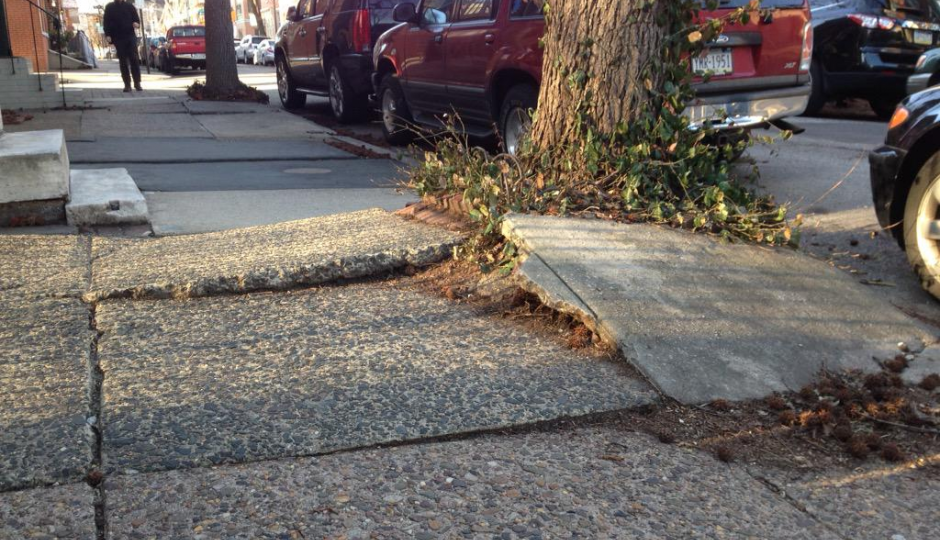
Image embedded from a 2015 article in PhillyMag on sidewalk hazards – 10 years later the problems remain.

This study builds off the methodology developed in our previous work to identify injurious falls by indoor versus outdoor location using Emergency Medical Services data from the 2019 National Emergency Medical Services Information System (NEMSIS) database. Here we classified the clinical severity of injurious falls using three injury severity measures that are used in the clinical setting to help guide the care response of on-scene EMS: (1) the Revised Trauma Score for Triage (T-RTS) (2) Glascow Coma Scale (GCS) and (3) patient clinical acuity. For injured patients who fell indoors vs outdoors on streets or sidewalks, the proportions were comparable for GCS scores in the moderate or severe range, T-RTS scores indicating need for transport to a Trauma Center, and EMS acuity rated as Emergent or Critical. The proportion of severe outdoor falls on streets and sidewalks was higher among men compared to women. The severity of injurious falls on streets and sidewalks was greater for young and middle-aged adults than injurious indoor falls but this pattern was reversed for older adults.

BEH team members Katie Burford and Nicole Itzkowitz led this research.

Posted in Injury, Pedestrian Injury, Physical Activity, Safety, Walkability | Leave a comment