What’s this about?
The Built Environment & Health (BEH) project is an interdisciplinary program of research at Columbia University. Led by epidemiologist Andrew Rundle, BEH uses spatial data to examine the implications of the built environment, including land use, public transit, and housing, for physical activity, diet, obesity, and other aspects of health. With a focus on New York City, BEH research will inform public policy to promote health in the city and metropolitan area. BEH is affiliated with the Robert Wood Johnson Foundation Health & Society Scholars program at Columbia.
Collaboration with PPS to Study Farmers’ Markets
New Grant
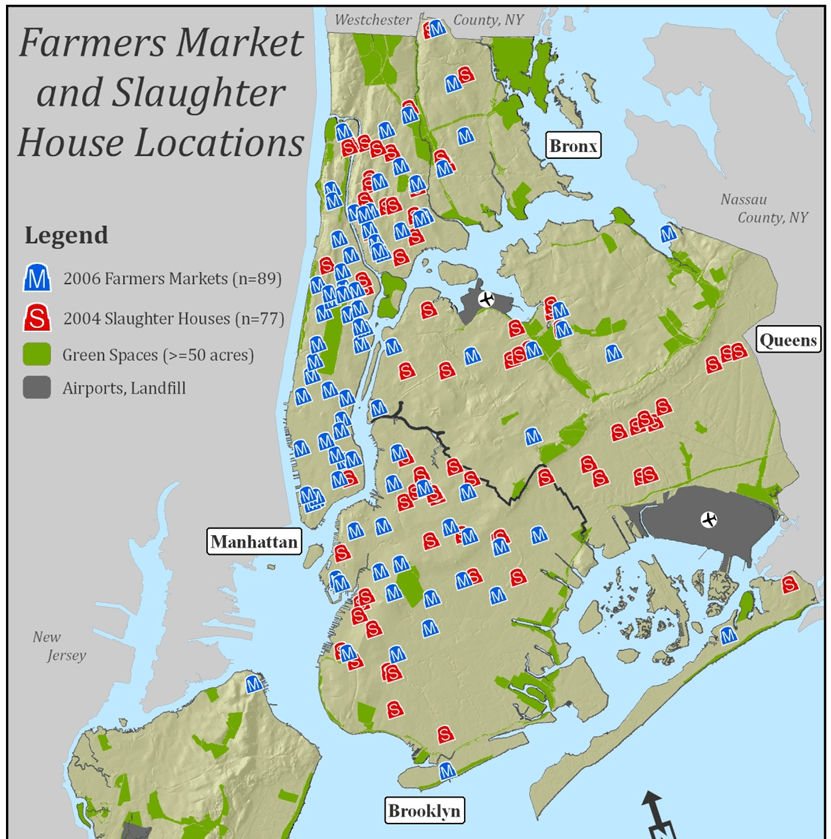
The Robert Wood Johnson Foundation Healthy Eating Research program recently awarded funding to a collaboration between BEH and the Project for Public Spaces (PPS), a New York City-based nonprofit. The project, “Farmers Markets as a Strategy to Improve Access to Healthy Food for Low-Income Families and Communities,” builds on a national PPS program to support farmers’ markets. Over the last several years, with support from the Ford Foundation and the Kellogg Foundation, PPS has provided funding and technical assistance to help farmers’ markets become economically sustainable and community-centered. The new project will examine the factors that make farmers’ markets successful in low- to moderate-income communities, with a focus on youth. As part of the project, researchers will return to eight farmers’ markets that received PPS funding to survey market customers and other neighborhood residents about food access in their communities.
Key personnel on the project include Stephen Davies (PPS), the principal investigator, along with Chris Heitman and Kelly Williams at PPS and Kathryn Neckerman, Marnie Puciel, and Paulette Yousefzadeh at BEH.
PPS and BEH also collaborated in the summer of 2007 on an observation-based study of neighborhood walkability.


