Built Environment and Health Project

What does it matter if you live on 2nd Street or 6th Avenue?

Does how you get from A to B affect your health?

What’s this about?

The Built Environment & Health (BEH) project is an interdisciplinary program of research at Columbia University. Led by epidemiologist Andrew Rundle, BEH uses spatial data to examine the implications of the built environment, including land use, public transit, and housing, for physical activity, diet, obesity, and other aspects of health. With a focus on New York City, BEH research will inform public policy to promote health in the city and metropolitan area. BEH is affiliated with the Robert Wood Johnson Foundation Health & Society Scholars program at Columbia.

Observational Validation of Urban Design Measures for New York City

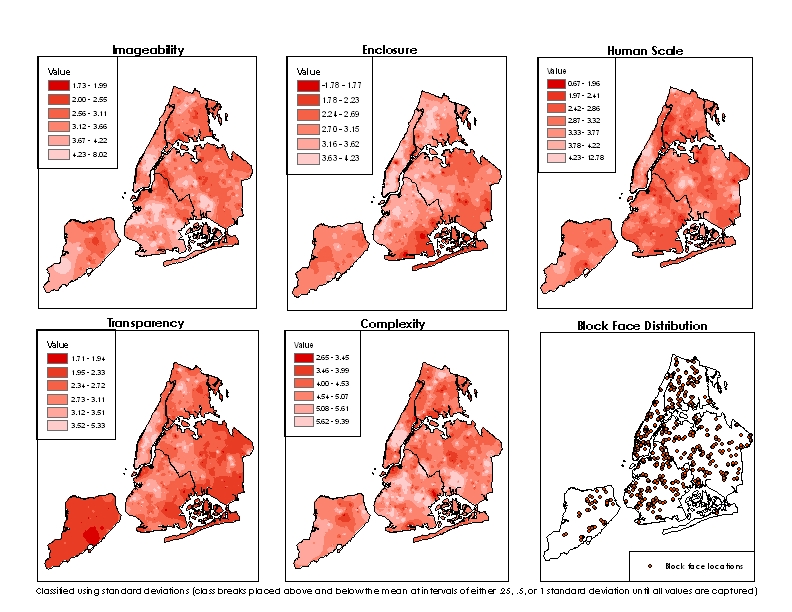
The BEH project was recently awarded funding to develop measures of aesthetic features of urban environment in New York City. The project builds on work by urbanists such as Jane Jacobs and Kevin Lynch, who proposed that aesthetic features of urban neighborhoods promote pedestrian activity. Design qualities such as imageability, complexity, enclosure, transparency, and human scale are said to provide visual stimulation, help people orient themselves, and offer a sense of safety and connection to the streetscape. However, empirical study of the influence of urban design has been slowed by the fact that we lack validated measures of urban design that are suitable for large-scale research.

A recent project led by Reid Ewing at the University of Maryland developed a set of observational measures of urban design, here termed the Maryland Urban Design Instrument (MUDI). Based on video clips of street scenes in a number of U.S. cities, his team identified features of the physical environment that could readily be coded by field observers. In consultation with Ewing and his colleagues, our project implements these measures in a sample of 600 New York City blocks and uses the resulting observational data to validate digital measures of urban design (d-MUDI).

We are constructing and correlating observational and digital measures of five urban design qualities: imageability, enclosure, human scale, transparency, and complexity. Observational data were collected during the summer of 2006 by a team of six field workers. The corresponding digital measures will be constructed for the same blocks using geospatial data available from a variety of sources including the PLUTO database maintained by the New York City Department of City Planning. We will use the observational measures to assess the validity of the d-MUDI. Then we will construct the same urban design measures for the entire city and analyze whether these measures predict Body Mass Index (BMI) and physical activity in our human health data sets. Research associate Marnie Purciel directed the fieldwork and is working with James Quinn to construct the digital measures.

This work provides a rare opportunity to explore whether aesthetically pleasing city environments promote health by encouraging walking. As more and more cities collect spatially-referenced data on local land use and the built environment, digital measures of urban design can be used more widely.

Funding is provided by Robert Wood Johnson Foundation Active Living Research, Award No. 58089, from July 2006 through June 2007. Project personnel include principal investigator Andrew Rundle; co-investigators Kathryn Neckerman and Christopher Weiss; research associates Marnie Purciel and James Quinn; and field staff Catherine Chang, Silvett Garcia, Jits Gysen, Victoria Lowerson, Joshua Margul, Ellen Marrone.

Built Environment and Health Project

Columbia University
International Affairs Building

420 West 118th Street
8th Floor, mail code 3355
New York, New York 10027

Tel. 212 - 854 - 7813
beh-project@columbia.edu

Skanking Blues Brother
fuckemall.info <body bgcolor="#ffffff" text="#000000"> <a href="http://searchportal.information.com/?o_id=65014&domainname=fuckemall.info">Click here to enter</a>. </body>